Comparator
Which one do I take, exactly?
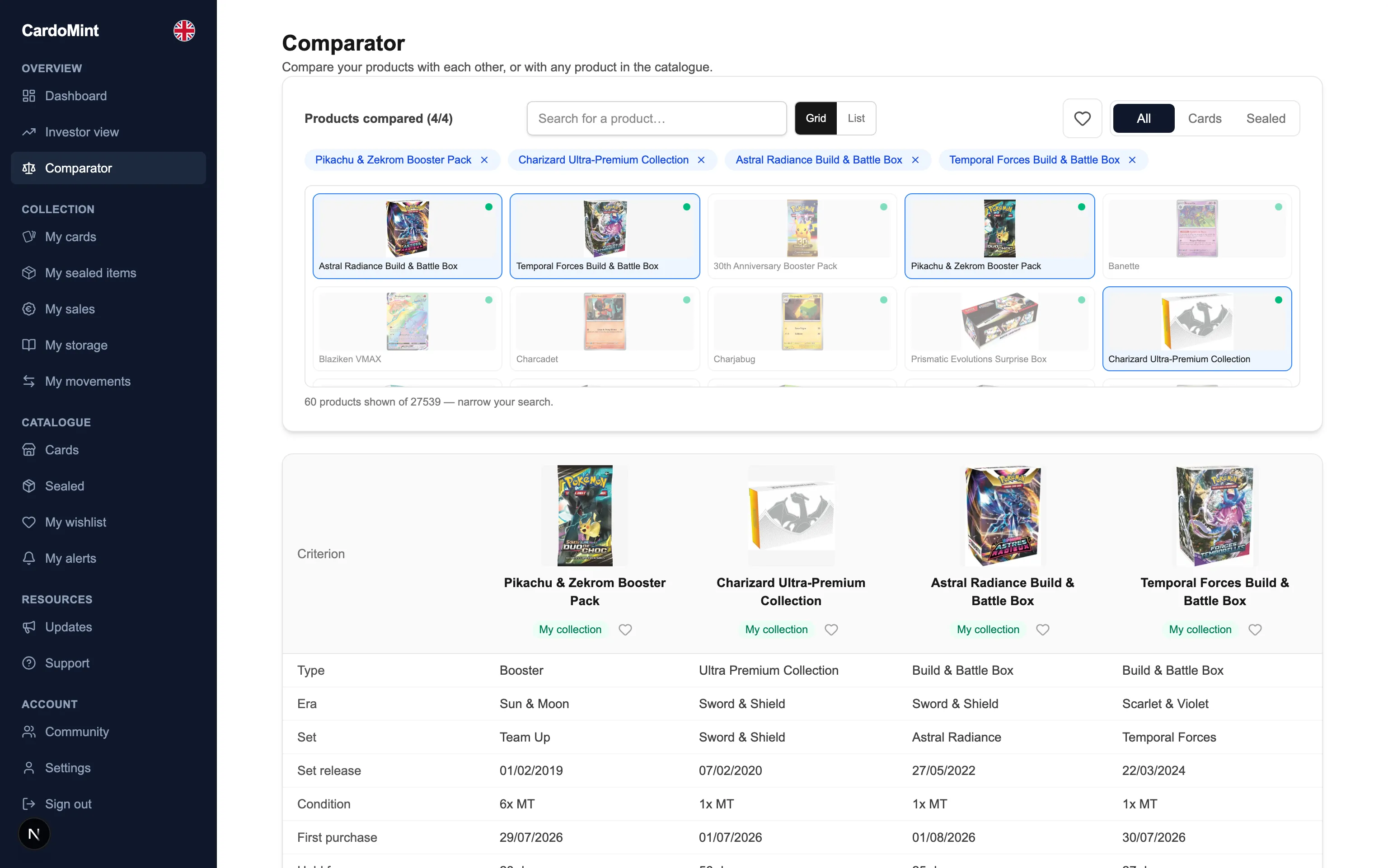
Two to four products on the same row, 17 criteria, and the best figure of each row marked. Owned, or simply in the catalogue.
- The table pins its first row and its first column: you read a value always knowing which product and which criterion it comes from.
- On the gap to the recommended price, the ranking inverts — paying less is the good outcome.
- One row says how many readings the displayed value rests on, because an estimate with no reading and an estimate with thirty are not worth the same.
Two, or four
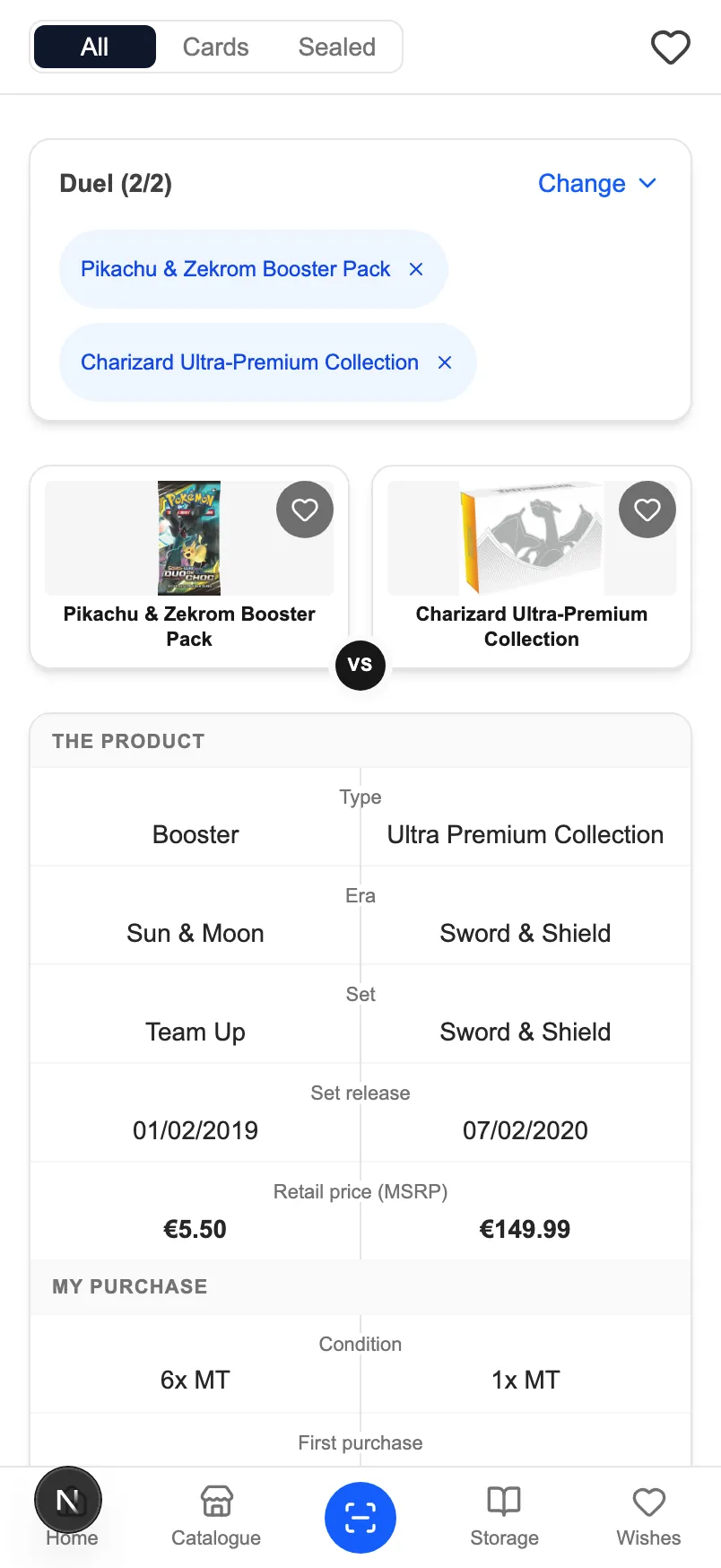
A duel on a phone, a table on a wide screen.
The number of columns follows the room available: two products face to face by thumb, up to four side by side on a laptop. The content itself does not change.
- On a phone the two products show as a duel, and the table keeps its criteria column visible while you scroll.
- On a laptop, up to four columns, with the header row and the criteria column both pinned.
- You add a product from the search — 70,578 in the catalogue — or by ticking one of your own.
The 17 criteria, one by one
Grouped in the three families the table displays: what the product is, what it cost you, what it is worth today.
The product · 5 criteria
What the object is, regardless of who owns it.
- Type
- Booster, ETB, box set, display… one of the catalogue's 27 families.
- Era
- The era the set belongs to — Scarlet & Violet, Sword & Shield, EX…
- Set
- The exact set, in the market it appeared in.
- Set release
- The release date. Two performances do not read the same depending on the product's age.
- Catalogue price (MSRP)
- The public price at launch. It is the one figure owned products and catalogue-only products share — so the only one that ranks everybody.
My purchase · 7 criteria
What the product cost you, and how long you have held it.
- Condition
- The condition of the copies held, summarised when they differ — « 3x MT & 1x NM ».
- First purchase
- The date of the oldest batch. It is what opens the holding period.
- Holding
- The number of days elapsed since that first purchase.
- Quantity
- The number of copies, across all batches.
- Unit price
- What one copy cost on average.
- Total cost
- The unit price multiplied by the quantity — what actually left your pocket.
- Gap to catalogue price
- The price paid against the public price. It is the one row where the ranking inverts: paying below the recommended price is the good outcome.
What it is worth today · 5 criteria
What the market says, and what that figure rests on.
- Current value
- The latest reading multiplied by the quantity held.
- Profit / Loss
- Current value minus total cost. A latent amount — it becomes realised on the day of a sale.
- Performance
- The same gap as a percentage, with a one-month floor on the denominator for annualisation.
- Share of portfolio
- This product's weight in the collection's total value. Unsigned: it is a share, not a variation.
- Price readings
- How many readings the displayed value rests on. This row says what the three above are built from.
How the table reads
Four rules, each answering a way of getting it wrong.
1 / 4
- The best figure is marked
- On every comparable row, a pill marks the best value. Descriptive rows — type, era, set — carry none: there is nothing to win there.
- One row inverts, and says so
- On the gap to the recommended price, the LOWEST amount wins. The rule is written under the row rather than left to be guessed.
- A catalogue-only product shows dashes
- With no copy in the collection it has no cost, no holding period and no performance — a zero there would read as a value of nothing. It stays comparable on its recommended price and on its identity.
- Readings are a row of the table
- The displayed value comes from the latest reading when there is one, from the catalogue's Cardmarket price otherwise, and from the purchase price as a last resort. This row says which of the three was used.
All of it is open from day one
The entire app is available by invitation, free of charge.