Access and pricing
Free today, on an invitation.
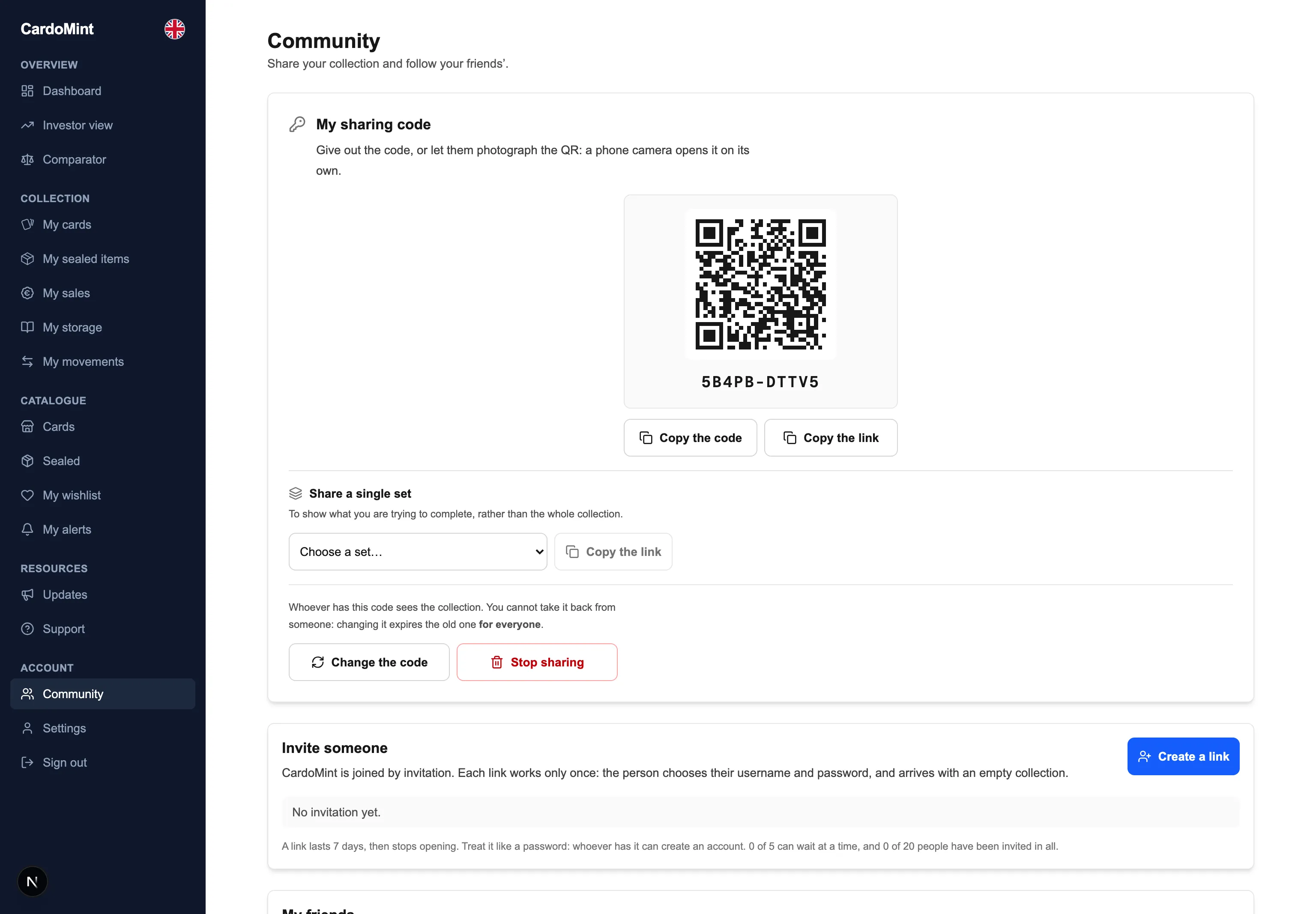
Everything CardoMint does today is open, with no tier and no limit. You come in through a link a member sends — five pending, seven days, twenty people.
- The invitation link works once, and is kept afterwards: it is the record of who let whom in.
- A sixteen-symbol recovery code reopens an account, and the email reset has arrived.
- The price of any paid tier will be written here with the date it was settled on — like every figure on this site.
Today — how you get in
- One link, one person
- Each invitation works exactly once. Once used it is kept: it says who let whom in, and the community screen shows it.
- Five links pending
- What is bounded is what is OUTSTANDING, never the total: five rights of entry can circulate at a time. A link used frees its place at once for the next.
- Seven days
- Enough to survive a weekend and someone who reads their messages late. An expired link gives its place back to the quota — it no longer blocks anything.
- Twenty people per member
- More people than anyone follows collections of, and the count includes links still pending: a right in circulation already reserves its place.
- Asking for an invitation
- An email is enough. Every request is read and answered; the link arrives with what to do next.
What access includes
- The whole Pokémon catalogue — 70,578 products, three markets, browse without limit.
- The collection: purchase batches, languages, printings, conditions, grading, binders and boxes.
- Daily valuation and performance, per batch and for the whole.
- Sales, movements, the investor view and the comparator.
- Sharing by link and by QR, and friends.
- The Excel export of the collection and the sales.
Measured on the database: 70,578 products, 1,014 sets, 11,640 cards priced daily.
The account, once you are in
- Recovery code
- Sixteen symbols, shown once, hashed like a password. Single-use: once served, it is replaced by a fresh one.
- Email reset
- A single-use link, valid for an hour, signed from the root domain — that is what is verified with the sending service. The answer is the same whether the address exists or not.
- Passwords
- PBKDF2-HMAC-SHA256, 210,000 rounds, the round count stored with the salt so it can be raised without invalidating accounts.
- Friends and blocking
- You add each other by share code, never by nickname. Blocking someone closes the friends path; a code already given goes on opening the showcase, and the screen says so.
- Deleting an account
- The password is required — a word retyped proves nothing about who retyped it — and the session dies with the row. The screen first names everything the deletion takes with it.
- Export at any time
- An Excel workbook of the collection and the sales, in two sheets, with dates, currencies and percentages in the right format.
Tomorrow — what a paid tier would add
A long price history
Today CardoMint writes one reading per card per day, and the history starts the day the card was first opened. A history spanning years is built day after day: the source publishes a price, never a series.
The next step
Time, literally. Every day recorded brings the horizon closer.
Sales actually completed
A Cardmarket price is an average of offers; what a collector wants to know is what the card sold for. Only eBay's « Marketplace Insights » API gives that.
The next step
It is on restricted access, and matching our 3,146 sealed products to listing titles is the bulk of the work — not the access.
Alerts that warn you
An alert is computed and seen by opening the page. Receiving a notification needs the same sending infrastructure as the email password reset, which has just arrived.
The next step
The sending service and the verified domain now exist; what is left is choosing what deserves to ring.
Card scanning
Point at a card rather than search for it. Its place is reserved in the app, and its tier — free or paid — is still to be settled.
The next step
The recognition itself. See the page devoted to it.
Several collections
Keeping an investment portfolio apart from a personal collection, with separate valuations.
The next step
A product decision, still open: the data already knows how to do it.
An API
Reading your collection from outside. The Excel export already answers half the need.
The next step
A public API is a contract: it is documented, versioned and held over time.
The price, and what will decide it
- The real cost is known
- Database, storage of the 84,000 photos and hosting. These are measurable expenses, and they grow with the number of people rather than with the number of cards.
- An offer is judged on what it adds
- What runs today stays open. The six candidates above are all additions, and that is the condition a tier will have to meet.
- Access is already bounded
- CardoMint is on invitation — five pending, twenty people per member. The question of volume comes with growth, not before.
- What will be written here
- The tier, what it contains, its monthly and yearly price, and the date those figures were settled on.
In the meantime, everything is open
The whole app is available on an invitation, free of charge.